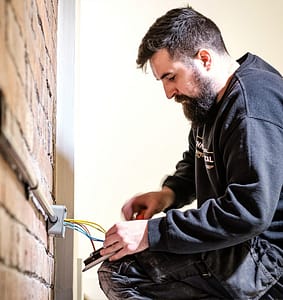
Electrical testing is the bread and butter of the sparkie’s trade. It’s a mandatory part of the EICR, it has to be done before any serious installation, and it’s actually one of my favourite aspects of the job. In fact, if I were to count, I’ve probably found millions of electrical faults in my time conducting electrical safety checks for homes and businesses throughout Yorkshire.
There are outdated systems, botched DIY jobs, procrastinated safety checks, mounting years of wear and tear, but no matter the culprit, electrical faults can be seriously dangerous if left unaddressed. But here’s the thing: many landlords, businesses, and homeowners don’t know what to look for—hence the purpose of this guide.
Here, I’ll walk you through the different electrical fault types, what causes them, and how to look out for the red flags, before rounding up with some advice on what to do. Time to get cracking!
Skip to:
- What are Electrical Faults
- Why They Need to be Dealt with Promptly
- Early Warning Signs
- Common Types of Electrical Faults + Their Fixes
- Understanding the Root Causes
- Prevention
- How & When to Reach Out to an Electrician
- Conclusion
What Exactly Is an Electrical Fault?
Distilled into its simplest definition, an electrical fault is a defect in an electrical system causing an abnormality in current. Essentially, it’s when things go wrong and disrupt the normal flow of electricity.
This can happen for a whole number of reasons – both human error and environmental – which I’ll get into later, but the most important thing to note is that electrical faults are not to be trifled with. Leading to power outages, damaged equipment and even a threat to life, faulty electrics, along with the misuse of electrical equipment, are a major cause of fires in the UK, accounting for over half of domestic fires in England between 2024 and 2025.
So, even if you’re not a technical person, having a general understanding of the risks electrical faults pose is super important to meet your responsibilities as a business owner or landlord, or to keep yourself and your loved ones safe.
Why They Need to be Dealt with Promptly
In a few words: it’s a necessity for safety. I’ve mentioned the correlation between faults and house fires, but the risks extend much further than that. For one, short circuits can lead to shocks or even explosions in the worst-case scenario; hazards whose harms don’t need explaining.
Then there’s the role of equipment damage, since excessive current may burn out motors, transformers and other essential components that keep your electrical appliances ticking along. Paired with the energy loss these faulty systems might be having on your circuits, it’s a recipe for inefficiency. And inefficiency = unnecessary cost.
Early Warning Signs to Keep an Eye Out For
When I’m out on the job, it’s not uncommon for homeowners to ask me how they can stay vigilant and pre-empt larger issues. One (simple) way to get started is peeling your eyes and pricking your ears to some of the following early warning signs:
- Loud buzzing or crackling coming from your electricals
- Heat, sparks and shocks from sockets/plugs
- Appliances or lights turning off unexpectedly
- Physical signs of wear and tear, like burn marks, discoloured sockets/switches and melted components
- Dead sockets/switches and misbehaving light fittings
- Electrics tripping when theoretically they shouldn’t
- Power cutting out randomly, throughout your home or in a single room
The Most Common Electrical Fault Types + How We Fix Them
There are numerous types of electrical faults, some quicker to spot than others, but generally they can be filed away under the following classifications.
Before you close this tab, don’t worry! I’ve cut out the jargon so they’re easy to follow. If you’re after a bit more of a practical explanation, though, do check out my fault-finding vlog. In it, I take you through my usual routine of inspection and the tests I carry out to locate the problems.
A word of caution, first: These examples are only meant as examples – under UK law, only qualified electricians should be undertaking this kind of work. If that’s not you, you’ll need to get in touch with the pros to sort out your issues.
Open Circuits
An open circuit fault, AKA a series fault, is where there’s a break or discontinuity in the conductor or circuit. What this means is that the current is forced to a halt, causing power supply interruptions in the affected load.
Diagnosis:
- Dead outlets, lights or appliances
- No continuity when tested with a multimeter
- Visual signs like snapped wires or loose terminals
Solution:
- Locate the break in the circuit through testing (continuity, voltage, resistance, RCD)
- Repair or replace damaged wiring or components
- Tighten or reconnect any loose terminations
Short Circuits
A short circuit occurs when current takes an unintended shortcut, usually when live and neutral wires come into direct contact. This causes a sudden surge of current, which can be very dangerous. Luckily, in this instance, your breakers should trip, making it hard for the electrical fault to go unnoticed.
Diagnosis:
- Circuit breakers tripping instantly
- Burning smells or scorch marks
- Fuses blowing repeatedly
Solution:
- Isolate the faulty section of the circuit, dividing the circuit into sections and testing them individually for continuity and insulation resistance
- Replace damaged cables or components
- Ensure proper insulation and separation of conductors
Overloaded Circuits
Exactly what it sounds like, an overloaded circuit occurs when too many devices draw power from the same circuit, exceeding its capacity.
Diagnosis:
- Frequent tripping when multiple appliances are in use
- Warm sockets or plugs
- Flickering lights when devices are switched on
Solution:
- Conduct PAT testing to check whether appliances and equipment are safe
- Redistribute electrical load across circuits
- Install additional circuits if required
- Upgrade consumer unit or wiring if capacity is insufficient
Earth Faults (AKA Ground Faults)
An earth faults are when current flows unintentionally to earth, often due to damaged insulation or faulty appliances.
Diagnosis:
- RCD (Residual Current Device) tripping
- Low resistance on an insulation resistance test
- High readings on an earth fault loop impedance test
- Tingling sensation from appliances
- Failed insulation resistance tests
Solution:
- Identify faulty appliances or wiring
- Repair insulation or replace damaged cables
- Ensure proper earthing and bonding are in place
Loose Connections
Loose connections are one of the most common (and overlooked) faults, often caused by poor installation or wear over time. It’s when fixtures degrade over time, causing weakened contact and, in turn, poor energy efficiency.
Diagnosis:
- Intermittent power loss and voltage drops
- Buzzing or crackling sounds
- Heat or discolouration at terminals
- High resistance on a multimeter test
Solution:
- Tighten all affected connections
- Replace worn terminals or accessories
- Re-terminate wiring to ensure secure contact
Arc Faults
Arc faults happen when electricity jumps across gaps in damaged or degraded wiring, creating high heat and fire risk. As such, these faults should be dealt with ASAP.
Diagnosis:
- Visible sparking or burning smell
- Charred wiring or outlets
- Unexplained tripping of protective devices
Solution:
- Replace damaged cables or components
- Install Arc Fault Detection Devices (AFDDs) where appropriate
- Ensure wiring is properly insulated and secured
Understanding the Root Causes
Before we can get to prevention, we ought to walk things back right to where things started: the root of the problem. With a solid understanding of what’s causing your issues, you can start to put together the scaffolding to ward off those pesky faults and keep your properties’ circuits running smoothly, safely and efficiently.
Outdated Systems
By far the most widespread issue I come across in my work is old, crusty systems. In my neck of the woods, Yorkshire, we’re no strangers to period properties with legacy equipment and interesting electrical setups with as much character as the architecture.
The reason these types of systems are so prone to faults is that they tend to lack the capacity and safety features of their modern counterparts. I often come across fuse boxes past their prime, missing RDC protection, undersized wiring, among a whole manner of issues that bring down performance.
As I mentioned in our rewiring guide, we sparkies recommend revisiting your wiring every 10 years to keep an eye on potential faults and inefficiencies, but also to future-proof your home. For instance, if solar is on the cards or you’re eyeing up a popular EV charger, you might wish to plan for increased capacity. Whatever the case, outdated electrical systems are only holding you back.
Previous Botched Jobs
Sometimes, when you see a DIY leccy job, all you can do is sigh and roll your eyes. Whether it was an unscrupulous landlord, the previous occupants, or a rogue trader, non-compliant installations are a serious hazard, and one of the most prevalent electrical fault causes, given that a quarter of adults have potentially done illegal electrical work with their own two hands, according to shared by Direct Line.
Of these unlawful installations, overloaded circuits, undersized wiring, unsecured connections, dodgy grounding and, of course, no installation certificate to be found are the hallmarks. To protect yourself, the only person going anywhere need your circuits should be a professional with sufficient knowledge of electrical standards (BS 761) and experience, plus the qualifications to back it up.
Preventing & Managing Electrical Faults
With the causes out of the way, we can finally turn our attention to preventing electrical faults in the first place. Here are just a few steps you can take to mitigate the risk.
- Never carry out DIY installations; a qualified electrical engineer with qualifications from approved certification bodies, like NICEIC or NAPIT, should be your only port of call.
- Get a professional in for periodic inspections as recommended by your safety certificate or estimated timeline.
- Try not to overload outlets with a mess of extension cords and tons of appliances plugged into one place.
- Use approved electrical appliances and always match light bulbs to the recommended wattage.
- Safeguard appliances, cords and outlets from moisture.
- Keep an eye out for the warning signs mentioned earlier.
How & When to Reach Out to an Electrician
When the early warning signs crop up, that’s your cue to take action. Likewise, if your EICR renewal date is quickly rolling around or you’re planning a renovation requiring significant installation work, it’s time to call in the experts. Stop using the affected circuit – especially if you’re seeing signs of corrosion, overheating and sparks.
Now, a quick word of advice: always check the electrician’s reviews on reputable sites (Google Reviews, Checkatrade or Trust A Trader) and ask to see accreditation. Sadly, there are cowboys out there who will try to exploit your inexperience.
The biggest red flag to heed is how long the inspection takes. Somewhat paradoxically, the companies who are the best are paid the least. Why? Because scammers want to waste your time to rack up the bill! 99% of our faults are found within the first hour, and are either quickly sorted or remedial action pencilled in for a later date.
Top tip: If you’re ever left uncertain, Citizens Advice has plenty of resources for reporting rogue traders and looking out for red flags.
Conclusion: Prevention is Always Better Than Cure
Look, I know: the urge to kick the can down the road is powerful at times, especially if the symptoms you spot are easy to ignore. But don’t let them mount up.
What can start off as a nuisance – a crackling plug contributing to the white noise or a stubborn flickering bulb – can snowball into something decidedly more sinister. And, honestly, for the peace of mind alone, getting your electrics looked at by a certified professional is well worth it. The early bird catches the worm and all that!
So, if you’re worried about the state of your circuits or your EICR is overdue, give me a shout. With Finney Electrical, what you see is what you get: top-notch service from sparkies who care.