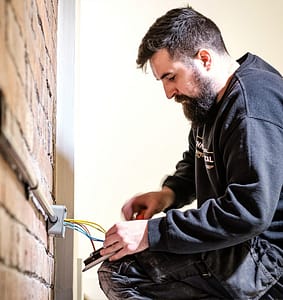
As of March 2025, the UK hit the milestone of 75,000 available public EV chargers, with a new one added to the network every 29 minutes according to the Department for Transport. Now that number’s looking closer to 90,000, and home charging infrastructure is looking up too, installations surpassing one million – hundreds of which were installed by my team at Finney Electrical. But which brands are making the best EV chargers for UK homes? And, more importantly, how do you choose?
Well, lucky you. I’ve just put together this breakdown of the top-performing brands to save you on the research, along with some insider tips I’ve picked up in my 14 years as a sparkie.
Skip to:
- What makes a good EV charger for UK homes
- Our Criteria
- Quick comparison of the best EV chargers
- Installer insights on popular models
- How to choose the right charger for your property
- Conclusion
What Makes a Good EV Charger for UK Homes?
You own an electric vehicle. Maybe you’re sick to death of battling through traffic to charge up. Perhaps you’ve cottoned on to the long-term cost savings you could make by investing in a home charging point.
Whatever the case, there are so many benefits in bringing your car charger to your driveway that extend much further than the price tag: with the freedom to choose from the best EV charger models, you can curate your experience, from the speed and efficiency of the charge right down to the looks of the wall mount or freestanding pedestal. But often with optionality comes decision fatigue…
No worries, I have the remedy! Here are the most crucial factors to mull over before you take the plunge with your search for the best car charger for your home.
-
- Charging speed and efficiency: With noticeable ramifications for daily convenience and your wallet, choosing a model that meets your day-to-day needs should be a top priority. Level 1 (3-pin) chargers are cheaper upfront yet slower and less efficient, whilst level 2 perform more cost-effectively but take longer to pay themselves off at a higher price tag.
- Smart features (that are genuinely useful): Some EV models have every smart feature under the sun, but before you get carried away by the flashy ones, try to prioritise those that really matter. Access to exclusive tariffs, including dynamic and solar charging; on-the-go, intuitive scheduling through a smart charging app; and per-minute consumption breakdowns help you make the most of your money. But do you really need dynamic load balancing if you’re a single-person household? Worth thinking about.
- Build quality, including weather resistance: These are absolutely essential as the UK’s winters get drearier and wetter year on year. Don’t forget about surge protection or repair services either – they’ll save you in the long run and prevent unnecessary materials from going to landfill.
- Future proofing: EV chargers are a big investment in the future – both on a planetary and personal scale – so they ought to be engineered to stand the test of time. That includes the ability to upgrade and tweak your setup as your requirements change.
- Compatibility with solar and a range of tariffs: If your home’s system already has solar integrated, it’s high time you bring your EV into the mix to exploit the potential savings. As such, you’ll need a charge point that works with the best tariffs and gives you the flexibility to choose.
- App reliability: Easily overlooked, the functionality and performance of your charge point’s app can make the difference between a frictionless experience and a daily annoyance that builds up, so do check those reviews!
- Customer service: In the event that something goes wrong, prompt, reliable customer service is everything, especially when you’ve got places to be.
- Tethered vs untethered: That is the question! Tethered chargers feature a cable permanently attached to the charging box at one end, and are generally viewed as less of a faff (particularly in the pouring rain!). Untethered chargers, however, plug in at both ends, allowing you to source and switch out your own cable.
Our Criteria
Before I jump headfirst into the specs, let me explain how exactly we’ve arrived at these rankings. Our evaluation relies on a mix of firsthand experience installing some of these models, reviews and customer feedback, as well as their real-world versatility and performance.
Of course, as I stated up top, your priority features will determine which EV charger is best for you, but as a rule of thumb, we shone the spotlight on those that blended value, quality, style and user-friendliness – this includes smart features, customisation options and the potential for future upgrades later down the line.
*Note that prices are hardware only and don’t include installation. Accurate at time of writing – February 2026.
Quick Glance Comparison
|
Brand |
Price |
Compatibility |
Power |
Tariffs |
Warranty |
Reviews |
Stand-out features |
|
£690 with a £25 discount available to essential workers and Blue Badge holders |
Type 1 and type 2, tethered, solar charging, dynamic load management |
7.4kW (32A) |
Smart tariff compatible with Ovo, Octopus, and soon, EDF |
3 years standard, plus the option to upgrade to 5 |
4.8/5 ⭐ |
IP66 rated ingress protection, 95% UV protected, LED and colour customisation, safety lock feature, intelligent control and scheduling |
|
|
From £399 |
Type 2, tethered, untethered, solar integration, dynamic load monitoring kit available |
Up to 7.4kW (32A) |
Smart tariff integration |
3 years |
4.7/5 ⭐ |
Made in the UK, a simple, compact yet robust design, strong earth leakage protection, and easy installation |
|
|
From £779 inc. VAT |
Type 2 tethered, untethered, solar integration |
7kW (1ph) or 22kW (3ph) |
Smart tariff integration |
3 years |
4 / 5 ⭐ |
Future-proof British-made design, in-built WiFi connectivity, high-tech surge protection |
|
|
From £411.99, depending on supplier |
Tethered type 2, dynamic and solar charging integration |
7.4kW (32A) |
Smart tariff integration |
3 years |
4.7/5 ⭐ |
Built-in LCD screen, multicar app functionality, detailed consumption controls and analytics, 3G/4G connectivity |
|
|
From £649 |
Tethered, untethered, freestanding or wall mount, dynamic and solar charging integration |
7kW or 22kW |
Intelligent Octopus Go tariff compatible |
10 years |
4.3/5 ⭐ |
Elegant appearance and design customisation, vehicle-to-grid upgradable, British-made, great build quality |
|
|
£499-£600~, depending on supplier |
2 in 1 tethered/ untethered, type 2, dynamic charging and solar integration
|
7.4kW (32A) |
Smart tariff integration |
3 years |
4.4/5 ⭐ |
24/7 updates, compact design, won Autotrader’s ‘Best Home Charger 2024’, WiFi connectivity, open PEN conductor protection |
1. Hypervolt – Best for Customer Satisfaction
The first entry on my list has to be Hypervolt. I’ve installed many of these in my time and never heard a bad word about them from my clients – something that’s backed up by their sky-high customer reviews. So, why all the praise?
Well, it stands out as one of the best home EV chargers thanks to a healthy balance of smart features, build quality and user experience. With 7.4kW charging, solar compatibility and dynamic load management as standard, it suits most modern households without overcomplicating things.
Customers love the clean app interface and reliability, but it’s also IP66 rated and UV protected, making it a solid long-term option for UK weather. And, get this, it’s pretty customisable too, with the choice of three colours – UltraWhite, Space Grey and UltraBlack – and LED statuses to complement its sleek, minimal design. Throw in the ability to upgrade your warranty to 5 years, and we’re onto a winner.
Curious about the installation process? We actually recorded a day-in-the-life vid getting a Hypervolt set up for a customer in Yorkshire, so do give that a watch.
2. FastAmps – Best for Practicality
The Fast Amps Alpha7 is a no-brainer for homeowners who want a reliable, no-nonsense EV charger without paying for features they’ll rarely use, not to mention drawing the neighbours’ attention with bright LEDs! Starting from £399, it’s one of the more cost-effective options while still offering 7.4kW charging, solar integration and dynamic load monitoring capability – all you need really.
Made in Shropshire and built with strong earth leakage protection, it’s a practical choice for standard residential installs and saves you a lot in the long run. So, if your priority is durability, safety and straightforward functionality rather than flashy app extras, Fast Amps delivers excellent value. Supporting British business is just a lucky bonus!
Here’s what it looks like IRL, plus a demonstration of how easy it is to get these bad boys installed 👇
3. Zappi – Best Allrounder
Call me biased, but Zappi is one of my personal favourites. They look smart, and they do the job well, as simple as that – an achievement they’ve been rewarded for with an established presence in the market and great reviews from British customers.
The highlight for me is their versatility; available tethered and untethered, and in 7kW or 22kW versions, as well as providing smart charging with Eco, Eco+, and Fast modes, you can adjust the setup to gel with your requirements. Particularly popular with solar users thanks to its advanced integration options and smart tariff compatibility, it’s a great way to maximise free, green energy.
But that’s not all – the Zappi is also a British-made product, designed to stand the test of time, physically and with long-term upgrades in mind. While it sits at a higher price point, it’s a strong all-rounder for households planning to expand into solar, battery storage or additional EVs since its app provides such detailed energy breakdowns and access to smart tariffs.
4. Ohme – Best for Efficiency
If you take a peek at Ohme’s customer reviews, you’ll quickly see why it’s a popular choice among British homeowners. Demonstrating outstanding customer service through great maintenance, they really don’t mess around.
But beyond that reassurance, I’d say that its data-led design is the prime feature. Using real-time insights, Ohme will actively charge when electricity is cheaper and demand lower, integrating seamlessly with all energy suppliers and most smart tariffs.
It offers 7.4kW charging, built-in 3G/4G connectivity (so it doesn’t rely solely on home WiFi), and a clear LCD screen for easy control. While it includes detailed usage analytics, many customers benefit most from its automated cost-saving functionality rather than the data itself.
5. Simpson & Partner – Best for Aesthetics (That Don’t Compromise Function)
Talk about form and function! The Simpson & Partners Home Series V3 proves that the best EV charger doesn’t have to look industrial, not in the slightest. With customisable lids and finishes, it’s designed to complement modern homes and businesses, whether that’s the compact A4 paper-sized wall mount or the sleek freestanding charge point, ideal for curb-side installations.
Beyond its appearance, though, it offers 7kW or 22kW charging, solar integration and a market-leading 10-year warranty. It’s British-made, vehicle-to-grid upgradable and genuinely built to last, featuring active health monitoring and hardware fault detection as standard. On top of this, Simpson & Partner provide more advanced user access control and energy management, including compatibility with smart tariffs like Intelligent Octopus and Ovo Anytime.
While the brand modestly says it “looks nice”, it genuinely combines form and function better than most. So if aesthetics matter as much as longevity and you’re willing to shell out a little more for the full package, Simpson & Partner is your best bet.
6. Easee One – Best for Ease of Use
Last up, we have Easee One, a user-friendly model that won Autotrader’s ‘Best Home Charger’ award back in 2024. With automatic updates, open PEN conductor protection (no need for an earthing rod!) and the ability to adjust the current from low to high, it runs well with tons of cars and electrical setups.
Although, like many other EV chargers, it’s made from plastic, the body doesn’t feel cheap; it’s solid and robust, even when inserting or removing the cable. Its standout feature, however, is the Easee One’s versatile 2-in-1 tethered/untethered setup, which renders the decision between the convenience of a tethered unit and the flexibility of an untethered one obsolete. You can switch things up whenever the fancy takes you.
The only downside I see is that, while the app is intuitive and simple, if you want more advanced features like automatic syncing with your energy tariff for something along the lines of Octopus Agile, you’ll have to look elsewhere.
How to choose the right charger for your property
Despite the title of this guide, there isn’t one single “best EV charger” for everyone. The right one depends on your home, how your electrics are set up, and how you actually use your car day to day.
We’ve fitted chargers on brand-new estates, 1930s semis, city terraces and rural properties from York to Wakefield, and the approach isn’t the same for each. Before choosing a brand, it’s worth briefly stepping back and looking at the bigger picture.
Property Type & Logistics
Start with the basics: where will the charger go, and how far is that from your consumer unit?
If your driveway is right next to the house and your board is in the hallway, it’s usually a clean, straightforward job (like those in the videos above). If your parking is at the end of the garden or in a detached garage, that’s when cable runs, access and routing start to influence both design and cost.
Older properties we typically deal with in York and across West Yorkshire sometimes need a bit more thought. We often find limited spare capacity, older earthing arrangements or consumer units that weren’t designed with EV charging in mind – which doesn’t necessarily mean you can’t get a charger installed, just that extra considerations are required for the job.
And if you’re planning ahead for solar panels, battery storage or even a second EV, it makes sense to choose a charger that won’t box you in later.
For business owners, the conversation shifts slightly. For instance, if you’re a business owner seeking to install commercial EV chargers, you might want to equip the charging points with payment systems so users can generate some supplementary revenue for you. That requires different hardware considerations from a standard domestic install.
Installation & Safety Considerations
The charger itself is only half the job. What sits behind it, your electrical system, is what really determines whether the installation will be safe and future-proof.
Every property should be properly assessed before installation. That includes checking load capacity, earthing, bonding and the condition of the consumer unit. If you’re unsure about the state of your electrics, it’s worth understanding what’s involved in an electrical safety check before committing.
In some homes, especially older ones, an EV installation can highlight issues that have been there for years, especially with fuseboards, which very occasionally might need replacing prior to the install. If you’re wondering what these checks involve or what it typically costs, we’ve explained it in detail in our EICR certificate cost guide.
Costs, Grants & What Affects Pricing
While the brand does indeed carry implications for the end price tag, it’s more the installation requirements and your choice of installer that impact the bill.
A straightforward installation – short cable run, modern consumer unit, no upgrades needed – will sit at the lower end of the scale. Once distance increases, walls need chasing out, or the fuseboard needs upgrading; that’s when costs increase
Fortunately, you can offset some of that by looking at the available chargepoint grants the government is currently offering. TL;DR, you can get 75% knocked off the cost of buying and installing a socket, up to a maximum of £350 if you meet the eligibility requirements!
Conclusion: It’s Time to Pick the Best EV Charger for You
There we have it – I’ve spilt my guts on everything I know about the best EV chargers on the UK market. As you’ll likely have gleaned, it’s not so complicated when all the facts are laid out, and it’s easy to get the ball rolling once you’re aware of the options. Speaking of…
If you’re ready to make the switch to greener, cleaner, cheaper (!) energy, get in touch with the guys at Finney Electrical. Because we want our customers to get the best possible deal, our quotes are competitive and our installations top-notch, from the moment you pick up the phone to your new EV charger being connected to the grid. Job’s a good’un.