
It might strike you as bizarre – dangerous – to know that, prior to 1916, electrical conductors weren’t labelled by colours. Yep, no bright shades to keep sparkies like us on the right path! Nowadays, the notion is unthinkable; we’re habituated to the standardised wire colours (yellow/green, brown, blue…) in the UK labelling system, so much so that it’s easy to forget that different standards exist around the world.
In this blitz of a guide, I’m going to run through the electric wire colours we use in the UK, shedding light on their history and how they’ve progressively changed, so that if you encounter the old wiring, you’ll know exactly what their outdated sheaths mean.
Safety alert! Never tackle wiring projects alone when you lack the experience or qualifications. If you’re even 1% unsure or stumble across unexpected colours, assume all wires are live and consult a certified electrician.
Skip on to…
- Wire Colours in the UK at a Glance
- Current Colours for Compliant UK Wiring
- Old Wiring Colours Some UK Homes Might Still Have
- How & Why Electric Wire Colours Changed
- Can You Mix Old & New Wiring Colours?
- Conclusion: If in Doubt, Get an Electrician to Help You Out
Wire Colours in the UK at a Glance
I get it, you’ve probably got places to be, people to see. So, here’s a quick rundown of the contemporary wire colours you’ll see in the UK. These standards align with European regulations and are mandatory for all British electrical installations and rewires.
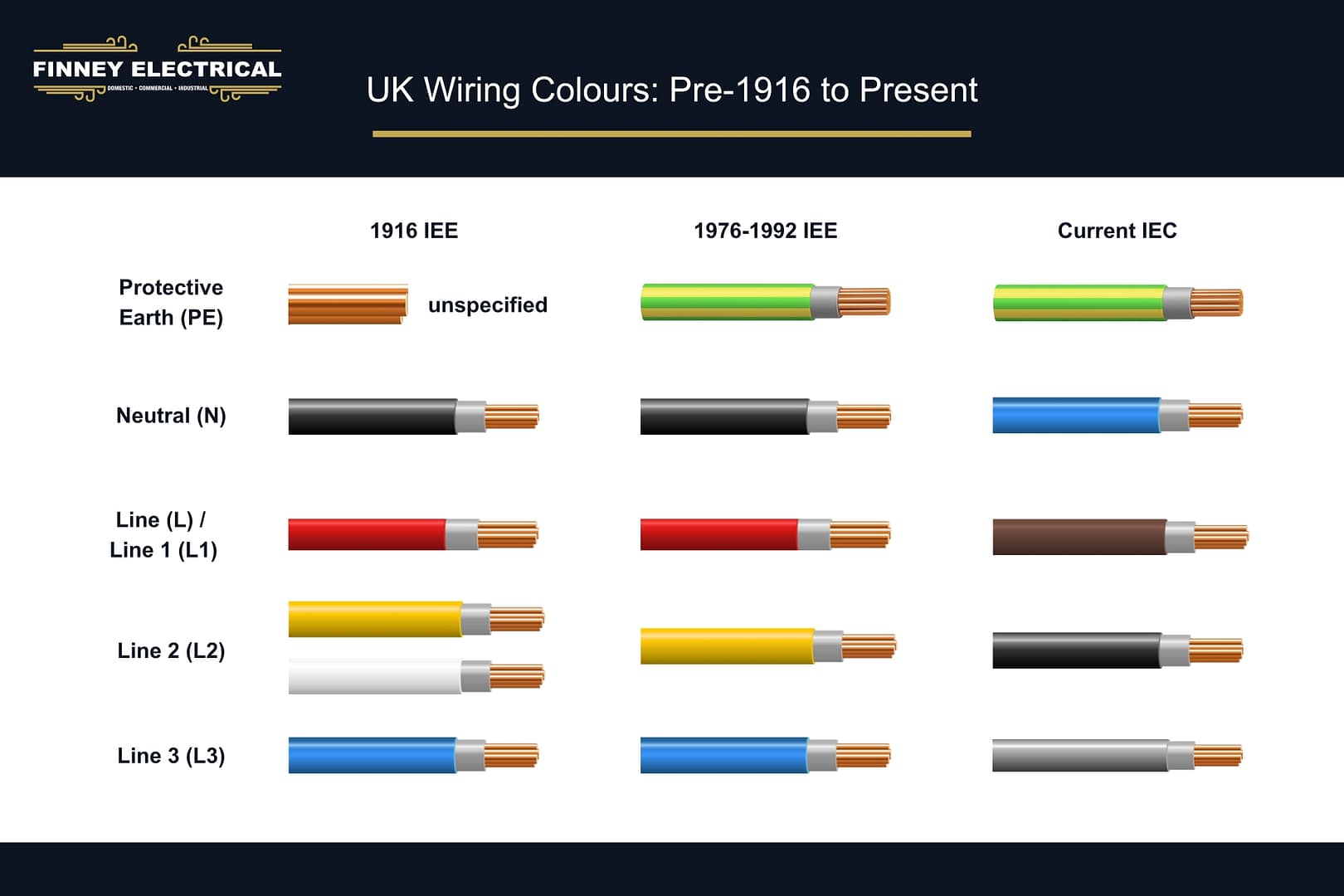
- Live (Phase): Brown (carries current to the appliance)
- Neutral: Blue (carries current away)
- Earth: Green and yellow stripes (safety feature for fault current)
Current Colours for Compliant UK Wiring (Post 2006 Installations)
As you’ll see from the infographic above, wire colours have shifted substantially over time in the UK – in fact, the graphic I pulled together is but a simplification of 110 years of modifications!
Enforced by the Electrical Appliances Regulations, these aren’t just recommendations but the legal standard. Any appliance – be it a plug you wired yourself or something professionally installed like an oven – and whole circuits fitted by an electrician need to follow the outlined colour codes in order to be compliant.
Single Phase (Standard Supply for Residential Homes)
Single-phase electricity is the standard supply used in most domestic households and even plenty of businesses. Quietly humming in the background, it’s the stuff keeping your lights on and powering your appliances, so you can boil the water for your morning cuppa.
You may have stumbled across the trio of wire colours in GCSE physics, but if not, here’s a quick reminder.
- The live wire – the one carrying electricity to the appliance in a circuit – is brown.
- The neutral wire, responsible for bringing electricity back to the power source and thus completing the circuit, is blue. Do be warned that, in all circuits, this blue wire receives a constant supply of electricity, making it particularly risky in terms of shocks.
- The earth wire comes sheathed in a conductor sporting green and yellow stripes. Its purpose is essentially a safety feature, providing a low-resistance path for the current to travel to earth in the event of a fault. This should trip a switch and disconnect the power to keep everything safe and sound.

Three Phase (For Commercial & Industrial Buildings)
On top of your bog standard single-phase electricity, we also have three-phase systems. This type of electricity is reserved for industrial or heavy-duty installations where a shed load of current is being used (400 volts compared to single-phase’s 230 V).
Sometimes, though, I’ve seen homeowners upgrade their systems from single phase supply to accommodate 22kW EV chargers – but more on that in my dedicated EV charger installation guide.
Back to wire colours: in British three-phase wiring setups, there are three live wires (sometimes called “hot legs” and an earth, as usual. The neutral wire is an optional addition for safety. Here’s what colour conductors they have:
- Phase 1 carries current back to the power source and is brown.
- Phase 2 brings electricity to the unit being powered, sporting a black wire casing.
- Phase 3, like phase 2, carries electricity to the unit. This one is grey.
- Neutral = blue
- Earth = green and yellow
Old Wiring Colours Some UK Homes Might Still Have
If you’ve ever poked around in an old property whose electricals were installed pre-2006, you might’ve noticed that something wasn’t adding up with the wiring. Yep, that’s right – prior to their current (pun unintended) colour standardisation, other colour codes were used. Turn back the clocks even further, and you’ll find that there were no official mandates, just a set of recommendations. Scary stuff.
That said, you needn’t worry too much about the colours themselves. We have record of previous regulations, all the way from their introduction in 1916 to the present day, so any qualified sparkie will know how to identify them if you’re unsure.
If your residence or rental property has pre-2006 wiring, the colours to expect are…
- Black for neutral
- Red for live
- Green or yellow + green stripes for earth
Is Old Wiring Safe?
Annoyingly, I can’t give you a straight answer as it depends on a slew of factors. For instance, how old are we talking, 2004 or 1980? Was the work carried out by a certified electrician? How much wear and tear has the system experienced? The answers will vary significantly between properties, especially if you haven’t been keeping on top of your EICRs.
What I can say, though, is that old, poorly maintained wiring has the potential to be highly dangerous, through age, outdated installations, and an accumulation of faults. As cables age, their insulation degrades, leaving live wires exposed and prone to short circuits, which amount to severe fire and/or shock hazards.
If your home was built before the 1970s and still has original wiring, it likely lacks modern safety features and needs to be inspected immediately. On the contrary, got your recent EICR, and the electrical safety checks gave you the all clear? Then you’re right as rain.
Ultimately, the colours are there to identify the conductors, so won’t have an impact if the wiring itself was completely to a good standard.

A potted history of wiring colour identification courtesy of the IET.
How & Why Electric Wire Colours Changed
As is sadly the case with many health and safety advancements, wiring colours were introduced to curb accidents, the sorts of industrial incidents that took people’s lives in the early days of this technology. There’s a sombre truth to the phrase ‘health and safety legislation is written in blood’.
So, born out of necessity and created by a committee appointed by the Council of the Society of Telegraph Engineers (a predecessor of the IEE and the IET), the IEE Wiring Regulations came into existence in 1882. However, it wasn’t until 1916 that colour identification was officially recommended, paving the way for the Electrical Appliances (Colour Code) Regulations 1996 (not just a good year for footy) we still follow today.
I won’t go into the weeds, but as you can see from the diagram above, so much has changed in the course of a century! The major turning point, though, was 2004 when BS 7671 was amended to harmonise with European standards, giving us the green/yellow, brown, blue trio I know so well.
Can You Mix Old & New Wiring Colours?
It’s a given: plenty of homes still have the old wire colours from before the present-day standard was made obligatory in 2006. As such, mixed systems are a pretty common occurrence in period properties with extensions or partial rewires.
Hell, I’ve completed tons myself, zipping about Yorkshire from tall townhouse terraces in Wakefield to the higgledy piggledy properties in the heart of historic York.
As long as everything’s labelled correctly (emphasis on the consumer unit here!) and the wiring is completed with all the Ts crossed and the Is dotted, the system should be perfectly fine. Again, this sort of work ought to be left to a trustworthy electrician with the right qualifications to their name. For example, all of our sparkies are approved by City & Guilds and NAPIT, which are highly esteemed.
Conclusion: If in Doubt, Get an Electrician to Help You Out
At the end of the day, if these electrical wire colours have you confounded, that’s a sign you need to get the professionals on board. Wink wink, nudge nudge.
Whether you’re rewiring a house for a big renovation or just want the peace of mind that the leccy in a new place you’ve bought is up to scratch, we’re your guys. At Finney Electrical, we take immense pride in our work, and that means treating customers to the gold-star service: full qualifications, rapid quotes, impeccable communication and cleaning up after ourselves wherever we go.
Interested? Then contact us to get the ball rolling.
